Ian Thomas Lou Pomanti Time and Time Again
| Claret, Sweat & Tears | |
|---|---|
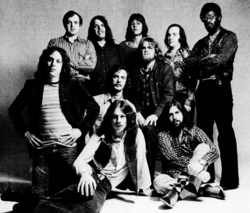 Group in 1972 | |
| Background information | |
| Origin | New York, U.S. |
| Genres |
|
| Years agile | 1967–1981, 1984–present |
| Labels |
|
| Website | bloodsweatandtears |
| Members | As of December 2016[update]:
|
Blood, Sweat & Tears is a jazz rock music group founded in New York Urban center in 1967. They are noted for their combination of contumely and rock band instrumentation. The grouping recorded songs past rock/folk songwriters such as Laura Nyro, James Taylor, the Band and the Rolling Stones as well as Billie Holiday and Erik Satie. They likewise incorporated music from Thelonious Monk and Sergei Prokofiev into their arrangements.
Since its beginnings, the band has gone through numerous iterations with varying personnel and has encompassed a multitude of musical styles. The ring is about notable for its fusion of rock, dejection, pop music, horn arrangements, and jazz improvisation into a hybrid that came to be known as "jazz rock". Unlike "jazz fusion" bands, which tend toward virtuosic displays of the instrumental facility and some experimentation with electric instruments, the songs of Blood, Sweat & Tears merged the stylings of rock, pop and R&B/soul music with large ring, while also adding elements of 20th-century classical and small philharmonic jazz traditions.
Al Kooper era [edit]
The group was inspired past the "contumely-rock" ideas of the Buckinghams and its producer, James William Guercio, as well as the early 1960s Roulette-era Maynard Ferguson Orchestra.[2] Al Kooper, Bobby Colomby, Steve Katz, and Jim Fielder did a show at the Village Theatre (later renamed Fillmore Eastward) in New York Metropolis on September 16, 1967, with James Cotton wool Dejection Ring opening.[ citation needed ]
Kooper acted as the group's initial singer and musical director, having insisted on that position based on his work with the Dejection Project, his previous ring with Steve Katz.[3] Kooper had also contributed to recording sessions of Bob Dylan and others.[ commendation needed ] Colomby had played with various folk musicians. Fielder previously worked with Frank Zappa's Mothers of Invention and Buffalo Springfield.
Fred Lipsius and so joined the others a month later. A few more shows were played every bit a quintet before Lipsius recruited fellow horn players Dick Halligan, Randy Brecker, and Jerry Weiss. The octet debuted at the Cafe Au Go Proceed November 17–nineteen, 1967, then played The Scene the post-obit week. The band was a hit with the audition, who liked the innovative fusion of contemporary styles.
Afterwards signing to Columbia Records, the group released Child Is Father to the Homo. The debut album cover showed band members with child-sized versions of themselves. Growing artistic differences quickly resulted in personnel changes. Colomby and Katz wanted to move Kooper exclusively to keyboard and composing duties, while hiring a stronger vocalist for the group. This led to the departure of Kooper in Apr 1968.[4]
Kooper became a record producer for Columbia, but not before arranging some songs that would be on the next BS&T album.[5] [vi] The grouping's trumpeters, Randy Brecker and Jerry Weiss, also left and were replaced past Lew Soloff and Chuck Winfield.[3] Brecker joined Horace Silver's band with his brother Michael, and together they eventually formed their own horn-dominated musical outfits, Dreams and the Brecker Brothers. Jerry Weiss went on to starting time the similarly-styled group Ambergris.
David Clayton-Thomas era [edit]
After Kooper left the group, Colomby and Katz began to await for a new singer, because Alex Chilton (after the breakup of the soul-rock grouping the Box Tops but earlier the formation of Big Star),[7] Stephen Stills, and Laura Nyro. Ultimately, they decided upon David Clayton-Thomas, a Canadian singer, born in Surrey, England.[eight] Reportedly, folk singer Judy Collins had seen Clayton-Thomas perform at a New York City club and was so taken and moved by his performance that she told Colomby and Katz almost him (knowing that they were looking for a new lead vocalizer to front the band).[4] With her prodding, they went to see Clayton-Thomas perform and were so impressed that he was offered the role of lead singer in a reconstituted Blood Sweat & Tears. Trombonist Halligan took up the organ chores and Jerry Hyman joined to take over trombone. With new trumpeters Soloff and Winfield the now nine-fellow member ring debuted at New York's Cafe Au Go Get on June 18, 1968, kickoff a 2-week residency.
The grouping's second anthology, Blood, Sweat & Tears, was produced by James William Guercio and released in January 1969. It was more popular-oriented, featuring fewer compositions by the band. The record rapidly hit the top of the charts, winning Album of the Year at the Grammy Awards over the Beatles' Abbey Route, among other nominees.[3] Three hit singles were released from Blood, Sweat & Tears: a cover of Berry Gordy and Brenda Holloway's "You've Made Me And then Very Happy", Clayton-Thomas' "Spinning Bicycle", and a version of Nyro's "And When I Die".[iii] Each of these 3 No. 2 singles was on Billboard Magazine'southward Hot 100 chart for thirteen weeks.
The commercial and critical acclaim enjoyed past the band in 1969 culminated in an advent at Woodstock, in which the ring enjoyed headliner status.[4] The festival'south film crew even defenseless the band's opening number, "More and More", every bit they took to the stage. Only the band'southward manager at the time, Bennett Glotzer, ordered the movie crew to turn off the cameras and go out the stage since the band had non agreed nor been paid to be filmed.
While Blood, Sweat & Tears achieved commercial success alongside similarly configured ensembles such equally Chicago and the Electric Flag, the band had difficulty maintaining its status equally a counterculture icon at a time when tape company executives deemed this feature important as a tool to lure young consumers.[ citation needed ] This was compounded past the band going on a United States Department of Land-sponsored tour of Eastern Europe in May/June 1970.[4] Whatsoever voluntary association with the government was highly unpopular at the fourth dimension, and the band was ridiculed for it.[4] It is now known that the Land Department subtly requested the tour in exchange for more amicability on the issuance of a visa to Clayton-Thomas.[4]
Later returning to the U.S., the group released Claret, Sweat & Tears 3 (June 1970), produced by Roy Halee and drummer Colomby. The album was another popular success,[4] spawning hit singles with a cover of Carole King'southward "Hi-De-Ho" and some other Clayton-Thomas composition, "Lucretia MacEvil". While this was a successful attempt to recreate the amalgam of styles institute on the previous album, the band again depended almost exclusively on encompass material. Album reviews sometimes focused solely upon the band'southward willingness to work with the U.S. Land Section, without bothering to discuss the bodily music.[iv] Compounding the image problems of the band was a decision to play at Caesars Palace on the Las Vegas Strip, widely seen at the fourth dimension as a mainstream venue for acts that did non appoint in radical politics.
In late 1970, the band provided music for the soundtrack of the film comedy The Owl and the Pussycat , which starred Barbra Streisand and George Segal, further dissentious the grouping's underground reputation.
Following this period of controversy, the group reconvened in San Francisco in January 1971 with jazz writer/saxophonist Don Heckman serving every bit their producer. With Dave Bargeron replacing Jerry Hyman, they recorded cloth that would grade the ground of their fourth album, BS&T 4 (June 1971). For the showtime time since the first anthology, Blood, Sweat & Tears presented a repertoire of songs composed near entirely from within the group. Likewise included on the album is a cover of quondam member Al Kooper's "Holy John (John the Baptist)". Loaded with hooks and a broad variety of moods (featuring such songs every bit "Go Down Gamblin'", "Lisa, Mind to Me", "High on a Mountain", "Redemption"), BS&T 4 broke into the album charts, resulting in a golden record for the group. All the same, none of the singles from the anthology managed to state in the Peak thirty on whatever of the singles charts, and the period subsequently the release of the quaternary anthology began the grouping'southward commercial reject.[4]
Jerry Fisher era [edit]
After playing a final show at Anaheim Convention Middle on December 31, 1971, Clayton-Thomas left in early Jan 1972 to pursue a solo career. He was briefly replaced by Bobby Doyle and and so Jerry Fisher, who went on to front the next incarnation of Claret, Sweat & Tears. Fred Lipsius left as well and was briefly replaced by Joe Henderson, before Lou Marini settled into the new lineup. Another founding member, Dick Halligan, also departed, replaced by jazz pianist Larry Willis (from the Cannonball Adderley Quintet), and Swedish guitarist Georg Wadenius, from the popular Swedish outfit Made in Sweden, joined as lead guitarist effectually the same time.
The new edition of Claret, Sweat & Tears released New Blood in September 1972, which constitute the group moving into a more overtly jazz-fusion repertoire. The album broke through the Top 40 chart (the last BS&T LP to practice then) and spawned a striking single ("And then Long Dixie", chart height: 44) that received some airplay. Also included on the record was a comprehend version of Herbie Hancock'south "Maiden Voyage", featuring the voice/guitar soloing of Georg Wadenius.
In January 1973, Katz left to pursue a career equally a producer (for Lou Reed and others). Winfield departed as well, in March, and was replaced by Tom Malone.
Blood, Sweat & Tears' side by side album, No Sweat (June 1973), continued in a jazz-fusion vein and featured intricate horn work. Tom Malone'due south stay in the band was brief and he left to make way for jazz trumpeter John Madrid. Only Madrid's tenure was likewise brusk-lived and he never recorded with the band. Both Madrid and Soloff left in late 1973, making way for new horn player/arranger Tony Klatka on the adjacent release, Mirror Prototype (July 1974), which also saw the addition of vocalizer/saxophonist Jerry LaCroix (formerly of Edgar Winter'south White Trash), sax player Bill Tillman, bassist Ron McClure and the exodus of original bass player Jim Fielder. This recording features the adoption of a audio pitched betwixt Philly Soul and the mid-1970s albums by Herbie Hancock's Headhunters, along with aspirations to Chick Corea's jazz-fusion group Return to Forever.
Jerry LaCroix left BS&T to join Rare Earth after playing his final prove with them at Wollman Rink in New York'south Central Park on July 27, 1974. Luther Kent, a dejection vocalizer from New Orleans, was recruited to replace LaCroix.
Reformations [edit]
By the close of 1974, Jerry Fisher decided that he was tired of BS&T's heavy touring schedule, so Bobby Colomby, together with the band's director Fred Heller, engineered the return of David Clayton-Thomas in the hope of restoring the band to its former level of success. Clayton-Thomas agreed and met the current group at a concert in Milwaukee while Jerry Fisher and Luther Kent were still with the ring. All three singers concluded up on stage together before a wildly enthusiastic crowd.
The next album, New City in April 1975, featured Clayton-Thomas back fronting the band and independent one-half cover tunes (Janis Ian, Randy Newman, the Beatles, Blues Epitome) and half original material. New horn actor Joe Giorgianni joined for New Urban center, which charted higher (No. 47) than any of the band's previous albums since New Blood. This was chiefly the consequence of an entry in the singles charts with a encompass of the Beatles' "Got to Get You into My Life", which peaked at No. 62. But it however did not sell too every bit albums from the group's 1969–71 commercial peak menstruation.

In the summertime of 1975, BS&T recorded a live album that was released in Europe and Japan the following year as In Concert. This very aforementioned album was subsequently released in the United states of america as Alive and Improvised in May 1991. The album featured unlike guitarists on different nights: Georg Wadenius, Steve Khan and Mike Stern, the latter who took over permanently for a time (Jeff Richman filled in for Stern in mid-1976). Jazz percussionist Don Alias was besides nowadays for the alive album. Later its recording, Joe Giorgianni left and was replaced by Forrest Buchtel (formerly of Woody Herman'due south band).
Around the same time, Bobby Colomby discovered a talented bass histrion by the name of Jaco Pastorius in Florida. He produced Pastorius's first solo album in the autumn of 1975, which was released in the spring of 1976. In late 1975, Pastorius toured with BS&T subbing for Ron McClure and when McClure left in early on 1976, Colomby arranged for Pastorius to bring together the band, though he stayed for just about three months. On April ane, 1976, Pastorius officially joined Atmospheric condition Report where he became world-famous. When Pastorius left BS&T, he was briefly succeeded by Keith Jones, earlier Danny Trifan stepped in.
In 1975, Claret, Sweat & Tears was offered a slot at a Jazz concert to be held in Newport, Rhode Isle. The city authorities viewed the ring as a "rock" band and was concerned that it would attract a rowdy audience; information technology threatened to revoke the concert allow if Claret, Sweat & Tears was not removed from the program. Ultimately, concert organizers were merely able to force the effect frontwards via judicial injunction. The ensuing litigation reached the U.s.a. Supreme Court.[9]
In July 1976 More than Than E'er, produced past Bob James and featuring guest vocals past Patti Austin and appearances by a host of NYC session players, including pianist Richard Tee, guitarists Eric Gale and Hugh McCracken, trumpeter Jon Faddis and Eric Weissberg (banjo, dobro), was released just sold disappointingly. After information technology stalled at U.s. No. 165, Columbia Records dropped the band. At this fourth dimension Bobby Colomby, BS&T's sole remaining original fellow member, stopped touring with the group and Don Alias assumed sole percussion duties before leaving besides to make style for Roy McCurdy.
In 1977, BS&T was signed to ABC Records and they began working on their next release, Make New Twenty-four hour period (November 1977). The anthology was co-produced past Bobby Colomby. Simply Colomby's direct interest with the group ceased after its release, although he connected on as sole owner of the Blood Sweat and Tears trademark. Brand New Solar day garnered positive reviews but was not a major seller. At this same fourth dimension BS&T were said to exist recording tracks for an instrumental anthology with a personnel of Tony Klatka, Forrest Buchtel, Dave Bargeron, Pecker Tillman, Larry Willis, Danny Trifan, Roy McCurdy and Mike Stern, only this album never materialized.
During 1977, the BS&T lineup connected to exist ever fluctuating. Stern, Trifan, McCurdy, Buchtel and Tillman all departed to be succeeded respectively by Randy Bernsen, Neil Stubenhaus, Michael Lawrence and Gregory Herbert. Barry Finnerty and then took over guitar and Chris Albert trumpet when Bernsen and Lawrence left at the shut of '77.
In Jan 1978, the group undertook a European tour that ended abruptly later on 31-yr-old saxophonist Gregory Herbert died of a drug overdose in Amsterdam on January 31, 1978. Rocked by this shocking turn of events, the group returned home and temporarily ceased activity.
In 1979, with the encouragement of longtime BS&T manager Fred Heller, who had numerous requests for the ring to play more shows, David Clayton-Thomas decided to continue Claret, Sweat & Tears with an entirely new lineup that consisted of himself and other Canadian musicians (Kenny Marco – guitar, David Piltch – bass, Joe Sealy – keyboards, Bruce Cassidy – trumpet, flugelhorn, Earl Seymour – sax, flute, Steve Kennedy – sax, flute and Sally Chappis – drums, with Harvey Kogan shortly replacing Kennedy and Jack Scarangella succeeding Chappis).
The group signed to Artery Records subsidiary label LAX (MCA Records), with a slightly altered lineup of: David Clayton-Thomas (vocals, guitar), Robert Piltch (guitar), David Piltch (bass), Richard Martinez (keyboards), Bruce Cassidy (trumpet, flugelhorn), Earl Seymour (sax, flute), Vernon Dorge (sax, flute) and a returning Bobby Economou on drums, and with producer and arranger Jerry Goldstein, recorded the anthology Nuclear Blues (March 1980). The anthology was yet another attempt to reinvent the group, showcasing the band in a funk audio environs that recalled such acts as Tower of Power and LAX labelmates War (with whom BS&T did several shows in 1980). The album was regarded by many Blood, Sweat & Tears fans equally uncharacteristic of the group's best work.
During this menstruum, another live album was recorded at The Street Scene in Los Angeles, California on Oct 12, 1980 (this was somewhen released as Live in Feb 1995). Robert and David Piltch left shortly before this concert, as did Richard Martinez. They were replaced by Wayne Pedzwiatr on bass, Peter Harris on guitar and Lou Pomanti on keyboards. And Mic Gillette (from Tower of Power) replaced Cassidy on trumpet at the tail end of 1980. Following more touring, including Australia, this incarnation of the grouping disbanded in 1981.
Since he did not own the rights to the Blood Sweat & Tears proper name, Clayton-Thomas attempted to restart his solo career in 1983 after taking some time off. This acquired complications during his initial months on the route when promoters would book his group and instead use the Claret, Sweat & Tears proper name on the marquee. Consequently, his director at the fourth dimension, Larry Dorr, negotiated a licensing deal between himself and Bobby Colomby in 1984 for rights to tour using the band's proper noun.[ten]
For 20 years afterwards, Clayton-Thomas toured the concert circuit with a constantly changing roster of players (see roster beneath) as "Blood, Sweat & Tears" until his final deviation in November 2004. Clayton-Thomas, now residing back in his home land of Canada, continues his solo career and does occasional shows using only his name in promotional efforts.
In 1998, to celebrate 30 years afterward he kickoff joined the group, David Clayton-Thomas began work on a solo CD titled Bloodlines that featured a dozen former members of Blood, Sweat & Tears, (Tony Klatka, Fred Lipsius, Lew Soloff, Dave Bargeron, Randy Brecker and others) performing on the album and providing arrangements to some of the songs. Released in 1999, it was first but bachelor at Clayton-Thomas' concerts only made more widely bachelor in 2001.
The band continued on without Clayton-Thomas. Larry Dorr has been the ring's managing director (and much more) for over thirty years at present, and Blood Sweat & Tears is notwithstanding one of the most popular touring acts of all time. At terminal count, the overall number of BS&T members since the commencement is upwardly around 165 total people (meet roster below).
On March 12 and 13, 1993, Al Kooper organized ii shows at the Bottom Line in NYC that were advertised equally "A Silver Ceremony Celebration of the Archetype Anthology The Child Is Father to the Man", which featured Al, Randy Brecker, Jim Fielder, Steve Katz and Fred Lipsius playing together for the first time in 25 years, accompanied by Anton Fig, Tom Malone, Lew Soloff, John Simon and Jimmy Vivino, likewise as a two-woman chorus and string department.
The post-obit year, in early February 1994, Al returned to the Bottom Line for his 50th birthday celebration, in which he played with members of his new ring plus the Dejection Project & BS&T. The BS&T lineup at this prove was the same every bit the 1993 Silver Anniversary show, with the exception of Will Lee sitting in for Fielder and John Sebastian (ex-Loving Spoonful) contributing harmonica. Colomby would not allow Kooper to employ the name Blood, Sweat & Tears, and then the two reunions were billed as "Child Is Father To The Man". This second prove appeared as the CD Soul of a Man in 1995. According to page 20 of the CD'southward liner notes, Steve Katz elected non to permit his performances onto the CD, which were digitally replaced by Jimmy Vivino. Bassist Jim Fielder is said[ by whom? ] to have added some parts to the CD equally well.
Since late 2005, the band resumed touring with a refreshed line up. The ring'south first world tour in a decade took identify in 2007. From 2008 through 2010, Steve Katz returned to appear at BS&T's shows as a special guest. BS&T and Chicago co-headlined a Jazz festival in Stuttgart, Frg on July 9, 2011, and they also appeared on the same bill together again at Gretna Heritage Festival in Gretna, Louisiana on October 5, 2013.
From 2013 until 2018, Claret Sweat and Tears was fronted past Bo Bice, who was the runner-upwardly against Carrie Underwood in the fourth season of American Idol.
In 2018 the grouping decided to supervene upon Bice with former Belfry of Power singer Tom Bowes, who had previously done a brief stint with BS&T dorsum in July through Nov 2012.
In 2019 Keith Paluso, from the reality Telly show The Vocalisation, was chosen as BS&T's new singer.
Blood, Sweat & Tears continues its heavy touring schedule throughout the globe. Nether the direction of Larry Dorr and founding fellow member/owner Bobby Colomby, the ring has enjoyed something of a resurgence. Blood, Sweat & Tears donated money through its "Elsie Monica Colomby" music scholarship fund to deserving schools and students who demand aid in prolonging their musical education, such every bit the victims of Hurricane Katrina.[eleven]
All of the band's albums, with the exception of Brand New Day, are currently[ when? ] available on compact disc. BS&T's showtime four albums were reissued by Sony Records in remastered editions (typically with bonus textile), except for its third album which was reissued by Mobile Allegiance. The after Columbia albums have been reissued by Wounded Bird Records, and Rhino Records has reissued Nuclear Dejection. Brand New Day was issued on CD in Russia in 2002, although the disc has not received authorization from copyright holders or record companies (counterfeit).
Members [edit]
- Keith Paluso: vocals
- Brad Mason: trumpet
- Jonathan Powell: trumpet
- Ken Gioffre: saxophone, flute
- Mike Boscarino: trombone
- Dylan Elise: drums
- Ric Fierabracci: bass guitar, vocals
- Julian Coryell: guitar, vocals
- Glenn McLelland: keyboards
By members [edit]
Original eight
- Al Kooper: keyboards, vocals (1967–1968)
- Randy Brecker: trumpet, flugelhorn (1967–1968)
- Jerry Weiss: trumpet, flugelhorn, backing vocals (1967–1968)
- Fred Lipsius: alto sax, keyboards (1967–1972)
- Dick Halligan: keyboards, trombone, horns, flute, backing vocals (1967–1972) †
- Steve Katz: guitar, harmonica, flute, mandolin, vocals (1967–73, and as a special guest at some shows 2008–x)
- Jim Fielder: bass, guitar, bankroll vocals (1967–1974)
- Bobby Colomby: drums, percussion, backing vocals (1967–1977)
Other members
- David Clayton-Thomas: vocals, guitar (1968–1972, 1974–1981, 1984–2004)[12]
- Lew Soloff: trumpet, flugelhorn (1968–1973) †
- Chuck Winfield: trumpet, flugelhorn, backing vocals (1968–1973)
- Jerry Hyman: trombones, recorder (1968–1970)
- Dave Bargeron: trombone, tuba, horns, bass, backing vocals (1970–1978)
- Bobby Doyle: vocals, pianoforte (1972) †
- Joe Henderson: tenor sax (1972) †
- Lou Marini Jr.: tenor & soprano sax, flute (1972–1974)
- Larry Willis: keyboards (1972–1978) †
- Georg Wadenius: guitar, vocals (1972–1975)
- Jerry Fisher: vocals (1972–1974)
- Tom Malone: trombone, trumpet, flugelhorn, alto sax, bass (1973)
- John Madrid: trumpet, flugelhorn (1973)
- Jerry LaCroix: vocals, alto sax, flute, harmonica (1974) †
- Ron McClure: bass (1974–1975, 1976)
- Tony Klatka: trumpet, horns (1974–1978)
- Neb Tillman: alto sax, flute, clarinet, backing vocals (1974–1977) †
- Luther Kent: vocals (1974)
- Joe Giorgianni: trumpet, flugelhorn (1974–1975)
- Jaco Pastorius: bass (1975–1976) †
- Steve Khan: guitar (1975)
- Mike Stern: guitar (1975–1977)
- Keith Jones: bass (1976)
- Danny Trifan: bass (1976–1977)
- Forrest Buchtel: trumpet (1975–1977)
- Don Alias: percussion (1975–1976) †
- Roy McCurdy: drums (1976–1977)
- Jeff Richman: guitar (1976 fill in for Stern)
- Randy Bernsen: guitar (1977)
- Barry Finnerty: guitar (1977–1978)
- Neil Stubenhaus: bass (1977–1978)
- Gregory Herbert: saxophone (1977–1978) †
- Michael Lawrence: trumpet (1977) †
- Chris Albert: trumpet (1977–1978)
- Bobby Economou: drums (1977–1978, 1979–1981, 1994–1995)
- Kenny Marco: guitar (1979)
- David Piltch: bass (1979–1980)
- Joe Sealy: keyboards (1979)
- Bruce Cassidy: trumpet, flugelhorn (1979–1980)
- Earl Seymour: sax, flute (1979–1981) †
- Steve Kennedy: sax, flute (1979)
- Emerge Chappis: drums (1979)
- Harvey Kogan: sax, flute (1979)
- Jack Scarangella: drums (1979)
- Vernon Dorge: sax, flute (1979–1981)
- Robert Piltch: guitar (1979–1980)
- Richard Martinez: keyboards (1979–1980)
- Wayne Pedzwater: bass (1980–1981)
- Peter Harris: guitar (1980–1981)
- Lou Pomanti: keyboards (1980–1981)
- Mic Gillette: trumpet (1980–1981) †
- James Kidwell: guitar (1984–1985)
- Jeff Andrews: bass (1984–1985)
- Taras Kovayl: keyboards (1984–1985)
- Tim Ouimette: trumpet, horns (1984–1985)
- Mario Cruz: sax, flute (1984–1985)
- Ricky Sebastian: drums (1984–1985)
- Steve Guttman: trumpet (1985–2005)
- Dave Gellis: guitar (1985–1990, 1996, fill in – 1998, 2005–2016, 2017, 2018)
- Ray Peterson: bass (1985–1986)
- Scott Kreitzer: sax, flute (1985–1986)
- Teddy Mulet: trombone (1985–1986), trumpet (2005–2013)
- Barry Danielian: trumpet (1985–1986, 2013–2014)
- Richard Sussman: keyboards (1985–1987)
- Randy Andos: trombone (1986)
- Tom Timko: sax, flute (1986–87, 1995, 1998–2001, 2005–08, 2009–x)
- Tom DeFaria: drums (1985–1986)
- John Conte: bass (1986–1987)
- Steve Conte: guitar (1986, 2013)
- Jeff Gellis: bass (1987–1990)
- Charley Gordon: trombone (1987, 1988–1994, 2001, 2013–2014)
- Dave Panichi: trombone (1987–1988, 1997–1998)
- Glenn McClelland: keyboards (1987–1993, 1998, 2005–present)
- Dave Riekenberg: sax, flute (1987–1990, 1995–1998)
- Jerry Sokolov: trumpet (1987–1994)
- Graham Hawthorne: drums (1987–1988, 1989–1991)
- Van Romaine: drums (1988–1989)
- Nick Saya: drums (1991)
- Neil Capolongo: drums (1991–1993)
- Peter Abbott: drums (make full in – early 1990s)
- Wayne Schuster: sax, flute (1990–1991)
- Larry DeBari: guitar, vocals (1990–1997) †
- Gary Foote: bass (1990–1994, 1996–2004, 2005–2012)
- Jack Bashcow: sax, flute (1992)
- Tim Ries: sax, flute (1992–1993, 1993–1995)
- Matt King: keyboards (1994–1998)
- Mike Mancini: keyboards (make full in – 1980s/1990s)
- Henry Hey: keyboards (make full in – mid-1990s)
- Cliff Korman: keyboards (fill in – mid-1990s)
- Mike DuClos: bass (1994–1996)
- Jonathan Peretz: drums (1995–1997)
- Craig Johnson: trumpet (1994–1998)
- Matt Milmerstadt: drums (1995, 1998)
- Tom Guarna: guitar (1997–1998)
- Jon Owens: trumpet (1998–2000)
- Charles Pillow: sax, flute (fill in – 1998)
- Brian Delaney: drums (1997–1998, 2001)
- Dave Stahl: trumpet (fill in – 1995–1999)
- Winston Byrd: trumpet (fill up in – 1998)
- Dave Pietro: sax, flute (make full in – 1998)
- Dale Kirkland: trombone (1995–96, 1998, 1999–2001, 2002–06, fill in – 2007)
- Pat Hallaran: trombone (1998–1999)
- James Fox: guitar (1998–2000)
- Dan Zank: keyboards (1998–2000)
- Zach Danziger: drums (1998–2001)
- Joe Mosello: trumpet (2000–2002)
- Gil Parris: guitar (2000)
- Gregg Sullivan: guitar (2000–2004)
- Phil Magallanes: keyboards (2000–2001)
- Andrea Valentini: drums (2001–2012)
- Darcy Hepner: sax, flute (1999 fill in, 2001–2004)
- John Samorian: keyboards (2001–2003)
- Nick Marchione: trumpet (2002–2004, fill-in – 2015)
- Eric Cortright: keyboards (2003–2004)
- Leo Huppert: bass (2004)
- Steve Jankowski: trumpet (2005–2013)
- Rob Paparozzi: vocals, harmonica (2005–2011)
- Scottie Wallace: vocals (alternating with Rob P. – 2005–2006)
- Thomas Connor: vocals (fill in – 2006 & 2007, 2012, early 2017)
- Tommy Mitchell: vocals (make full in ane show 2007)
- Jens Wendelboe: trombone (2006–2013)
- Chris Tedesco: trumpet (fill in for Mulet – 2007)
- Brian Steel: sax (fill up in – 2008)
- Nib Churchville: trumpet (fill in – 2008)
- Ken Gioffre: sax (2010–2015, 2016–present)
- Jon Pruitt: keyboards (make full in for McClelland – 2010)
- Ralph Bowen: sax (make full in for Gioffre – 2011)
- Dave Anderson: bass (fill up in for Foote – 2011, joined 2012–2013)
- Jason Paige: vocals (2011–2012)
- Bernard Purdie: drums (sat in for 1 tune 2011)
- Tom Bowes: vocals (2012, 2018)
- David Aldo: vocals (2012–2013)
- Joel Rosenblatt: drums (2012–2015, fill in for Elise - June 2017)
- Bo Bice: vocals (2013–2018)
- Jon Ossman: bass (2013–2014)
- Michael Davis: trombone (2013)
- Carl Fischer: trumpet (2013–2015, 2016)
- Dan Levine: trombone (2014 & 2015 – fill in, 2016–2018)
- Dillon Kondor: guitar (fill up-in – 2014-2016, 2017–2018)
- Buster Hemphill: bass (2014–2016, 2018 - make full in)
- Trevor Neumann: trumpet (2014–2016)
- Brandon Wright: sax (2014 – fill in)
- Dylan Elise: drums (2015–present)
- Mike Cottone: trumpet (2015–2016)
- Mike Boscarino: trombone (2015–2016, 2018, 2019)
- Ric Fierabracci: bass vocals (2016–nowadays)
- Brad Mason: trumpet- MD (2015, 2016–present)
- Leonardo Amuedo: guitar (2016)
- Jonathan Powell: trumpet (2017-2019)
- Mark Miller: trombone (2017, 2018 - fill in)
- Adam Klipple: keyboards (2017 & 2019 - make full in)
- Frank David Greene: trumpet (2017 - fill in)
- Anibal Rojas: sax (2017 & 2019 - fill in)
- Bryan Davis: trumpet (2017 - fill up in)
- Brian Bonvissuto: trombone (2017 - fill in)
- Greg Mayo: guitar (2018 - fill in)
- Julian Coryell: guitar vocals (2018, 2019 - fill in)
- Ozzie Melendez: trombone (2018 - fill up in)
- Chris Rodriguez: guitar vocals (2019)
- Keith Paluso: vocals (2019-present)
- Sam Ryan: vocals (2019 - make full in)
Discography [edit]
- Child Is Father to the Man (1968)
- Blood, Sweat & Tears (1969)
- Claret, Sweat & Tears 3 (1970)
- B, Due south & T; four (1971)
- New Blood (1972)
- No Sweat (1973)
- Mirror Image (1974)
- New Urban center (1975)
- More Than Ever (1976)
- Brand New Twenty-four hour period (1977)
- Nuclear Blues (1980)
References [edit]
- ^ "Blood Sweat and Tears - THE Ring". BloodSweatAndTears.com. three December 2016. Archived from the original on 2016-12-03. Retrieved Baronial 16, 2021.
- ^ "Backstage Passes & Backstabbing Bastards: Memoirs of a Rock 'N' Roll Survivor" - autobiography by Al Kooper - total citation needed - date=February 2022
- ^ a b c d Colin Larkin, ed. (1997). The Virgin Encyclopedia of Popular Music (Concise ed.). Virgin Books. p. 149. ISBN1-85227-745-9.
- ^ a b c d east f g h i Eder, Bruce (2007). "Blood, Sweat & Tears". VH1. Retrieved 2012-08-17 .
- ^ "Claret, Sweat and Tears Biography". Rolling Rock . Retrieved 24 December 2013.
- ^ "Blood, Sweat & Tears - Biography". Billboard. Archived from the original on 3 July 2015. Retrieved 24 December 2013.
- ^ Jovanovic, Rob. Big Star: The Story of Rock's Forgotten Band. London: Fourth Estate, 2004. ISBN 0-00-714908-5
- ^ "David Clayton-Thomas - Biography". Billboard. Archived from the original on 27 June 2015. Retrieved 24 December 2013.
- ^ City of New Port v. Fact Concerts, Inc., 453 U.S. 247 (1981)
- ^ "Blood, Sweat & Tears Discography & Biography". Replay Records. 2007. Archived from the original on 2007-12-29. Retrieved 2007-12-26 .
- ^ "Blood, Sweat & Tears official homepage". Blood, Sweat & Tears. 2007. Archived from the original on 2007-12-27. Retrieved 2007-12-26 .
- ^ David Clayton-Thomas interviewed on the Pop Chronicles (1970)
External links [edit]
- Official website
- VH1 ring history
- BS&T tribute website
- BS&T tribute website
- BS&T lineup 1967–2000
- Horn Rock Heaven MySpace site
- Blood, Sweat & Tears discography at Discogs
- Blood, Sweat & Tears at IMDb
Source: https://en.wikipedia.org/wiki/Blood,_Sweat_&_Tears

Post a Comment for "Ian Thomas Lou Pomanti Time and Time Again"